
Which legacy AI model was better for coding—and what should buyers use now?
| IMPORTANT 2026 STATUS NOTE |
| Claude 3 Opus was retired by Anthropic on January 5, 2026. GPT-4o is also an older OpenAI generation and is no longer the recommended starting point for new coding projects. This guide preserves the historical comparison, explains where each model was strong, and shows what a buyer should evaluate before choosing a current replacement. |
The 30-Second Verdict
| Choose Claude 3 Opus when… | Choose GPT-4o when… |
| • You need careful code explanations • You are reviewing architecture • You work with long technical documents • You value depth over speed | • You want fast back-and-forth coding • You use images, screenshots, or mixed media • You prototype frequently • You value responsiveness and flexibility |
| STACKCOMPARE WINNER |
| Historical overall winner for deep coding analysis: Claude 3 Opus. Historical winner for speed and multimodal development workflows: GPT-4o. For a new 2026 deployment, choose a current successor rather than either legacy model. |
At-a-Glance Comparison
| Category | Claude 3 Opus | GPT-4o | Edge |
|---|---|---|---|
| Deep reasoning | Excellent | Very good | Claude |
| Code generation | Excellent | Excellent | Tie |
| Debugging explanations | Excellent | Very good | Claude |
| Response speed | Good | Excellent | GPT-4o |
| Multimodal workflows | Limited compared with GPT-4o | Excellent | GPT-4o |
| Documentation | Excellent | Very good | Claude |
| Large-context analysis | Strong | Strong | Slight Claude edge |
| Current availability in 2026 | Retired | Legacy / not recommended starting point | Neither |
| Best for | Deep code analysis | Fast coding and multimodal work | Depends on your needs |
Visual Scorecard
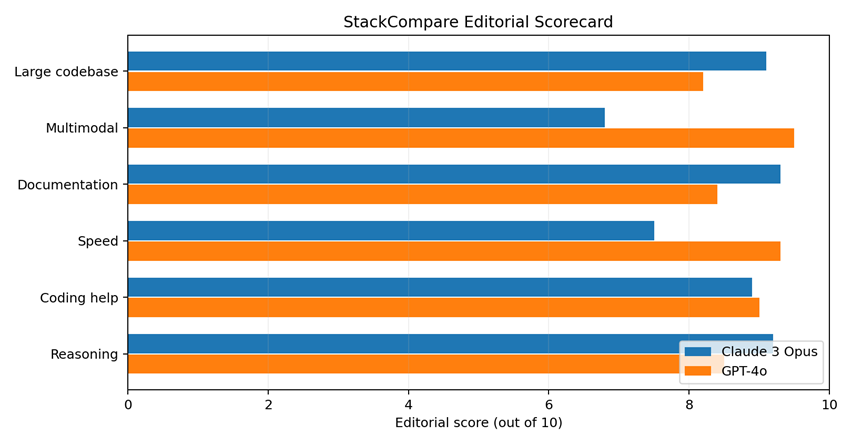
Editorial scores summarize the qualitative criteria in this guide. They are not laboratory benchmarks and should not be treated as permanent model rankings.
Executive Summary
Claude 3 Opus and GPT-4o represented two different styles of AI coding assistance. Claude 3 Opus was strongest when the developer needed a patient reviewer: explain this repository, trace this bug, compare architectural options, or rewrite documentation without losing nuance.
GPT-4o was strongest when the developer needed a fast collaborator: generate a component, interpret a screenshot, turn a rough idea into code, revise the output, and continue the conversation with minimal delay.
That difference matters because “best for coding” is not one task. Coding includes planning, generation, debugging, testing, documentation, refactoring, security review, and communication. A model can be excellent at one stage and merely adequate at another.
The most important 2026 conclusion is practical: both names are now legacy choices. Anthropic officially retired Claude 3 Opus on January 5, 2026, while OpenAI’s current model catalog recommends newer GPT-5.6-class models for complex reasoning and coding. Buyers should use this page to understand the trade-offs, then evaluate current successors using the same framework.
Sources checked July 31, 2026: Anthropic Model Deprecations; OpenAI Models documentation; OpenAI GPT-4o launch and system-card materials.
1. Coding Quality
Code generation
Both models could produce useful code across popular languages, but they often felt different in practice. GPT-4o usually moved faster from prompt to implementation. Claude 3 Opus often spent more effort explaining assumptions, edge cases, and trade-offs before presenting the final code.
- Claude advantage: clearer rationale for complex changes.
- GPT-4o advantage: faster iteration for common implementation tasks.
- Best practice: request tests, error handling, and a short explanation with every generated solution.
| BEST USE |
| For a quick prototype or UI component, GPT-4o was often the more fluid choice. For a high-risk refactor or architecture-sensitive change, Claude 3 Opus was usually easier to audit. |
Debugging
Claude 3 Opus tended to excel when the bug required tracing relationships across functions, describing why the failure occurred, and proposing several repair strategies. GPT-4o was highly effective for quick error-message analysis and iterative troubleshooting.
- Paste the smallest reproducible example.
- Include the expected result and the actual result.
- Ask the model to identify uncertainty instead of guessing.
- Run the proposed fix in a safe environment before production use.
Refactoring and maintainability
The best refactor is not the shortest code—it is the change that improves readability without breaking behavior. Claude’s longer explanations were useful for reviewing design patterns, dependencies, and migration risk. GPT-4o’s speed made it practical for repeated cleanup passes and style conversions.
2. Reasoning, Architecture, and Large Projects
For system design, Claude 3 Opus was the more natural fit. It frequently produced structured analyses that covered constraints, failure modes, migration paths, and operational consequences. GPT-4o could also reason well, but its greatest advantage was the speed of the conversation rather than the depth of a single answer.
| Task | Better historical fit | Why |
| Review a microservices proposal | Claude 3 Opus | More detailed discussion of dependencies and failure modes |
| Build a proof of concept today | GPT-4o | Faster iteration and strong general coding ability |
| Explain an unfamiliar repository | Claude 3 Opus | Strong long-form explanation and organization |
| Translate a screenshot into UI code | GPT-4o | Multimodal workflow was a core strength |
| Write an architecture decision record | Claude 3 Opus | Detailed technical writing and trade-off analysis |
3. Speed and Developer Experience
Speed changes how an AI assistant feels. A slightly weaker answer delivered quickly can be more useful during rapid prototyping, while a slower but more complete answer can save time during design reviews. GPT-4o’s original launch emphasized faster performance and stronger text, vision, and voice interaction. That made it especially attractive for interactive work.
- Choose speed when you are brainstorming, prototyping, or performing repetitive edits.
- Choose depth when a mistake would be expensive or difficult to detect.
- For serious work, combine quick generation with a second review pass.
4. Multimodal Development Workflows
GPT-4o’s standout advantage was multimodality. A developer could provide a screenshot, diagram, or interface mockup and ask for interpretation or code. Claude 3 Opus was more text-centered in this comparison.
| EXAMPLE WORKFLOW |
| Upload a screenshot of a dashboard → ask for a component hierarchy → request accessible HTML/CSS → generate test cases → compare the result against the original screenshot. |
Multimodal ability is valuable, but visual interpretation is not proof of correctness. Check spacing, accessibility, responsive behavior, and design-system consistency yourself.
5. Documentation and Communication
Claude 3 Opus was especially strong at transforming technical material into organized documentation. It could produce design notes, onboarding instructions, README files, and decision records with a consistent tone. GPT-4o was also capable, but Claude’s writing style often felt more deliberate for long technical explanations.
| Deliverable | Recommended historical model | Reason |
| README rewrite | Claude 3 Opus | Structured, detailed explanations |
| Inline comments | GPT-4o | Fast and concise |
| API documentation | Claude 3 Opus | Strong organization and completeness |
| Release notes | Tie | Both handled concise summaries well |
| User-facing tutorial | Tie | Depends on tone and desired length |
6. Security, Privacy, and Reliability
Neither model should be trusted as the final authority for secure code. AI-generated code can contain insecure defaults, outdated libraries, subtle logic errors, or fabricated APIs. The right workflow is assisted development—not unsupervised deployment.
- Never paste secrets, private keys, or regulated customer data into a tool without approved controls.
- Use static analysis, dependency scanning, unit tests, and human code review.
- Ask the model to list security assumptions and possible attack surfaces.
- Verify every library name, method, and version against official documentation.
| SAFETY RULE |
| Treat AI output like code from a capable but unfamiliar contractor: useful, fast, and always subject to review. |
7. Pricing and Value
A direct 2026 price comparison would be misleading because Claude 3 Opus has been retired and GPT-4o belongs to an older OpenAI generation. Historical prices are less useful than the current question: which active model gives your team the lowest total cost for acceptable output?
| Evaluate | Why it matters |
| Input and output token rates | Long codebases and verbose outputs can change total cost. |
| Context-window limits | A larger window may reduce manual chunking. |
| Caching and batch discounts | Repeated context can become much cheaper. |
| Latency and fast modes | Faster service may carry a premium. |
| Developer time saved | The cheapest model is not cheapest if it needs extensive correction. |
Current Anthropic pricing pages list newer Opus models; OpenAI’s pricing page lists its current model families. Always verify live pricing before publishing or purchasing.
8. Best Model by User Type
| User | Historical recommendation | Reason |
| Solo developer | GPT-4o | Fast, flexible, easy for daily back-and-forth |
| Senior engineer | Claude 3 Opus | Strong review and architecture explanations |
| Startup team | GPT-4o | Rapid prototyping and multimodal work |
| Enterprise architecture group | Claude 3 Opus | Detailed system-level analysis |
| Documentation-heavy team | Claude 3 Opus | Consistent long-form technical writing |
| Design-to-code workflow | GPT-4o | Strong screenshot and image interpretation |
9. Pros and Cons
| Claude 3 Opus | GPT-4o |
| PROS • Deep explanations • Strong architecture analysis • Excellent documentation • Good large-context reasoning CONS • Slower-feeling workflow • Less multimodal emphasis • Retired in 2026 | PROS • Fast interaction • Strong multimodal ability • Excellent general coding help • Smooth prototyping CONS • Complex reasoning may need more prompting • Legacy generation in 2026 • Human verification still essential |
10. Real-World Scenarios
Scenario A: Debugging a production service
You have logs, a stack trace, and several interacting services. Claude 3 Opus was the stronger first reviewer because it tended to map the system and explain competing causes. GPT-4o was useful for rapidly testing individual hypotheses.
Scenario B: Building a landing page from a mockup
GPT-4o was the clearer choice because the developer could combine visual input with iterative code generation. The model could inspect the layout, propose components, and revise the result quickly.
Scenario C: Migrating a legacy codebase
Claude 3 Opus was better suited to documenting dependencies, identifying migration risk, and outlining phases. GPT-4o remained useful for converting individual files and generating repetitive boilerplate.
Scenario D: Learning a new framework
Claude 3 Opus was strong for a long conceptual explanation. GPT-4o was strong for short examples and rapid questions. The better option depended on whether the learner wanted a textbook-style lesson or an interactive tutor.
11. How to Test Current Replacements
Do not select a 2026 coding model based on this historical winner alone. Run a small internal evaluation using your own work.
| Test | What to measure | Weight |
| Generate a feature | Correctness, clarity, test coverage | 25% |
| Debug a real issue | Root-cause accuracy and repair quality | 25% |
| Review architecture | Trade-offs, risks, completeness | 20% |
| Explain code | Accuracy and usefulness to your team | 15% |
| Measure workflow | Latency, edits required, total cost | 15% |
| BUYING TIP |
| Use identical prompts, identical files, and a blind reviewer when possible. Record correction time—not just first-answer quality. |
12. Frequently Asked Questions
Is Claude 3 Opus still available in 2026?
Anthropic’s official deprecation documentation says Claude Opus 3 was retired on January 5, 2026.
Is GPT-4o still the best OpenAI model for coding?
No. OpenAI’s current models page recommends newer GPT-5.6-class models for complex reasoning and coding.
Which one historically gave better explanations?
Claude 3 Opus generally had the edge for detailed reasoning, architecture, and documentation.
Which one historically felt faster?
GPT-4o generally offered the faster, more interactive experience.
Can either model replace a developer?
No. Both can accelerate work, but design judgment, testing, security review, and accountability remain human responsibilities.
Should a team use more than one model?
Yes, when the productivity gain justifies the complexity. Some teams use one model for fast generation and another for review.
Are star ratings objective benchmarks?
No. The ratings on this page are editorial summaries of the criteria described in the article.
What should I choose today?
Test current OpenAI and Anthropic coding models using your own repository and workflow. Avoid starting a new system on a retired model.
Final Verdict
| FINAL HISTORICAL VERDICT |
| Claude 3 Opus was the better choice for deep reasoning, architecture reviews, and detailed documentation. GPT-4o was the better choice for speed, multimodal workflows, and rapid daily coding. Neither should be the default choice for a new 2026 deployment because the market has moved to newer model generations. |
For StackCompare readers, the most useful next step is not to debate a retired winner. It is to apply the scorecard in this guide to the current models available from each provider. Test real tasks, measure correction time, and select the model that improves your team’s total productivity—not the one with the loudest marketing claim.
Related Comparisons
- Claude vs ChatGPT: Which AI Assistant Is Better?
- Cursor vs GitHub Copilot: Best AI Coding Tool
- Claude Code vs OpenAI Coding Tools
- Best AI Coding Assistants for Development Teams
Editorial Methodology and Sources
StackCompare.ai evaluates products using practical buyer criteria: capability, workflow fit, speed, usability, reliability, pricing, and current availability. Editorial ratings summarize these criteria and are not paid placement.
- Anthropic: Model Deprecations documentation (Claude Opus 3 retired January 5, 2026).
- Anthropic: Current Claude model and pricing documentation.
- OpenAI: Current Models documentation (newer GPT-5.6-class models recommended for coding and reasoning).
- OpenAI: GPT-4o launch announcement and GPT-4o System Card.
- OpenAI: Current API pricing documentation.
Last reviewed: July 31, 2026. Product availability, pricing, and model recommendations can change. Verify official provider pages before purchasing or publishing time-sensitive pricing.