ActiveCampaign vs ConvertKit (2026): Which Is Better?
Advanced lifecycle automation or a creator-first email business—which platform fits your growth model?
| IMPORTANT 2026 NAME AND PRICING NOTE |
| ConvertKit publicly rebranded to Kit in 2024. This guide retains “ConvertKit” in the title because buyers still search that name, but the current product is Kit. ActiveCampaign and Kit both change pricing, limits, AI packaging, subscriber/contact tiers, and promotional offers. As reviewed August 3, 2026, ActiveCampaign advertises packages starting at $15 per month and scales mainly by contacts and capabilities. Kit lists Creator starting at $39 per month and Creator Pro at $79 per month for up to 1,000 subscribers, with a free Newsletter plan and higher prices as the subscriber count grows. Verify live pricing before purchase or publication. |
The 30-Second Verdict
| Choose ActiveCampaign when… | Choose Kit (ConvertKit) when… |
| • You need deep, multi-step lifecycle automation • You want CRM, lead scoring, pipelines, or sales handoff • You market across email, SMS, WhatsApp, and integrations • Your customer journey depends on behavioral data | • You are a creator, author, coach, podcaster, or newsletter operator • You want a simpler subscriber-first workflow • You sell digital products, memberships, or subscriptions • You value fast publishing and creator-network growth tools |
| STACKCOMPARE WINNER |
| Best overall platform for sophisticated marketing automation, cross-channel orchestration, CRM, and revenue workflows: ActiveCampaign. Best platform for independent creators who want a focused email-first operating system, simple automations, creator growth tools, and native digital commerce: Kit. For a complex business, ActiveCampaign wins. For a creator-led business, Kit is usually the better fit. |
At-a-Glance Comparison
| Category | ActiveCampaign | Kit (ConvertKit) | Edge |
| Primary audience | SMBs, ecommerce, SaaS, agencies, marketing and sales teams | Creators, authors, coaches, podcasters, newsletter and course businesses | Different audiences |
| Automation | Deep branching, behavioral triggers, CRM and cross-channel workflows | Visual Automations, sequences, tags, events, creator funnel templates | ActiveCampaign |
| Email publishing | Campaigns, transactional and lifecycle messaging, segmentation, AI-assisted creation | Broadcasts, sequences, clean creator-focused editor and newsletter workflows | Depends |
| CRM and sales | Native deals, pipelines, lead scoring, assignments and sales reporting | Subscriber-centric; not a full sales CRM | ActiveCampaign |
| Creator growth | Useful forms and landing pages, but not the central product identity | Creator Network recommendations, referral tools, profiles and creator ecosystem | Kit |
| Commerce | Ecommerce integrations and automation around customer behavior | Native digital products, subscriptions and creator commerce | Kit for creators |
| Channels | Email plus optional SMS, WhatsApp, CRM and broad app ecosystem | Email-first with apps and integrations | ActiveCampaign |
| Ease of use | Powerful but requires process design and governance | Faster to learn for creator email workflows | Kit |
| Pricing model | Contacts, package, channels and advanced capabilities | Subscribers and plan level; Newsletter, Creator, Creator Pro | Depends |
| Best for | Complex customer journeys and marketing operations | Audience growth, newsletters and creator monetization | Depends |
Visual Scorecard
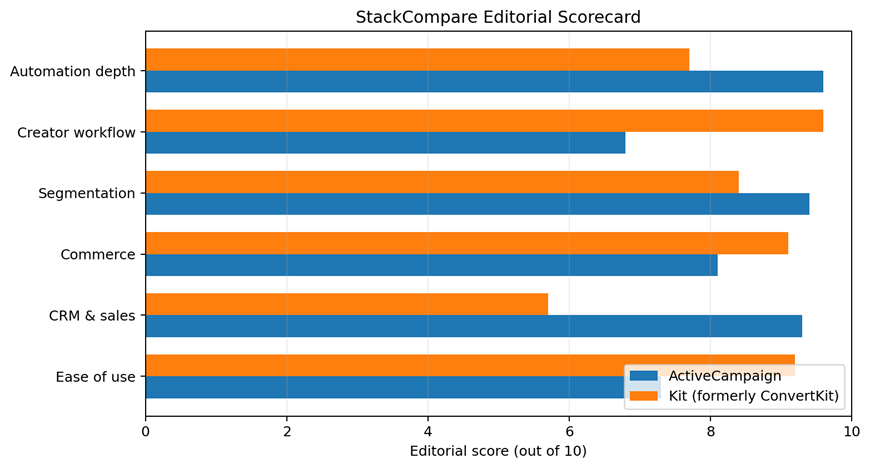
Editorial scores summarize the qualitative buyer criteria in this guide. They are not laboratory benchmarks and should not be treated as permanent product rankings.
Executive Summary
ActiveCampaign and Kit are both capable email marketing platforms, but they are built around different operating models. ActiveCampaign is a broad customer-experience and marketing-automation platform. Its core strength is coordinating data, segmentation, campaigns, lifecycle workflows, CRM activity, sales handoff, and multiple communication channels. Kit is an email-first operating system for creators. Its design centers on subscribers, broadcasts, sequences, visual automations, creator-to-creator recommendations, and direct monetization through digital products and subscriptions.
The strategic choice is therefore less about which editor has more buttons and more about the business you are building. A company with ecommerce events, lead scoring, multiple products, sales pipelines, regional teams, lifecycle stages, and complex branching usually needs the control and extensibility of ActiveCampaign. A creator who publishes consistently, sells expertise, grows through recommendations, and wants one clean audience database can often move faster with Kit.
ActiveCampaign has moved beyond classic “if this, then that” automation toward what it calls autonomous marketing and Active Intelligence. Its current product pages emphasize AI-assisted campaign creation, advanced segmentation, predictive sending, cross-channel execution, CRM, and more than 1,000 integrations. Kit has also expanded beyond newsletters. Its current product includes visual automations, app-based events, digital products, subscriptions, Creator Network recommendations, subscriber scoring on Creator Pro, advanced reporting, and increasingly sophisticated creator funnels.
For most buyers, the deciding factors should be workflow complexity, team structure, revenue model, and the cost of administration. ActiveCampaign can produce more precise orchestration, but that precision requires governance, testing, naming conventions, and ongoing maintenance. Kit intentionally removes much of that complexity, which is a strength for creators but a limitation for organizations that need full CRM and revenue operations.
Sources checked August 3, 2026: ActiveCampaign pricing, email marketing, marketing automation, CRM, and integrations pages; Kit pricing and plan documentation; Kit Visual Automations documentation; Kit commerce, features, and rebrand materials.
1. Core Purpose and Product Philosophy
ActiveCampaign: orchestrate the complete customer journey
ActiveCampaign is designed for organizations that need to coordinate marketing and sales activity around a shared customer record. It combines email marketing, segmentation, automation, analytics, CRM functions, and optional channels such as SMS and WhatsApp. The product assumes that customers may enter through different sources, behave differently over time, move between lifecycle stages, and require personalized treatment based on data and intent.
- Use behavioral and profile data to create dynamic segments.
- Build automations that branch based on engagement, purchases, scores, lifecycle stages, and CRM events.
- Coordinate campaigns across email and connected channels.
- Pass qualified contacts into sales workflows, deals, or account follow-up.
| BEST USE |
| ActiveCampaign is strongest when customer journeys are too complex for a linear newsletter sequence and the business has someone responsible for automation architecture, data quality, testing, and reporting. |
Kit: run a creator business with email at the center
Kit is optimized for people whose audience is the business: authors, coaches, educators, musicians, podcasters, YouTubers, paid-newsletter operators, and digital-product sellers. The platform treats subscribers, tags, sequences, broadcasts, recommendations, and purchases as the core objects. The interface is intentionally more focused than a broad CRM suite.
- Publish broadcasts and automated sequences without a heavy marketing-operations layer.
- Organize subscribers with tags and segments rather than multiple disconnected lists.
- Grow through forms, landing pages, recommendations, and the Creator Network.
- Sell digital products, memberships, and subscriptions directly through the platform.
2. Email Creation, Broadcasts, and Deliverability
Both platforms can send professional email, but they optimize for different kinds of teams. ActiveCampaign supports campaign creation inside a broader system of segmentation, personalization, reporting, and automation. Its current email product highlights an Email Designer, advanced segmentation, AI Campaign Builder, AI Content Generator, AI Image Generator, AI Brand Kit, predictive sending, and comprehensive reporting. Kit emphasizes a clean writing and publishing workflow, reusable templates, broadcasts, sequences, creator-friendly landing pages, and direct audience engagement.
| Use case | Better fit | Why |
| Weekly editorial newsletter | Kit | Fast creator workflow, subscriber focus, recommendations and monetization ecosystem |
| Behavior-triggered lifecycle campaign | ActiveCampaign | Deeper event data, branching, scoring and cross-channel coordination |
| Product launch sequence for a course | Kit | Simple sequence building, commerce and creator templates |
| Regional campaign with CRM and sales follow-up | ActiveCampaign | Shared customer data, assignments, deal context and reporting |
| One-person business publishing several times per week | Kit | Less administration and a more focused interface |
| Multi-brand or multi-location marketing operation | ActiveCampaign | Governance, segmentation and broader operational controls |
Deliverability is not guaranteed by choosing either vendor. Sender reputation, authentication, consent, list hygiene, engagement, complaint rates, content, and sending patterns still matter. ActiveCampaign promotes dedicated deliverability infrastructure and expert support. Kit provides deliverability reporting, with advanced provider-level reporting on Creator Pro. Buyers should test inbox placement with their own audience rather than rely on generic claims.
3. Automation Depth and Workflow Design
Automation is the clearest dividing line. ActiveCampaign is better for complex logic. A workflow can react to site behavior, purchases, message engagement, fields, tags, scores, dates, pipeline changes, and connected applications. The platform is suited to nested conditions, goal tracking, lead routing, deal creation, task assignment, and multi-channel coordination. In 2026, ActiveCampaign also emphasizes AI agents that can assist with campaign strategy, creation, activation, and validation.
Kit Visual Automations are easier to understand at a glance. Creators can connect forms, tags, purchases, sequences, delays, and conditions into a visual funnel. Kit supports branched subscriber journeys, link triggers, app events, and automation templates for welcomes, launches, evergreen funnels, courses, upsells, re-engagement, and abandoned carts. Its strength is making common creator workflows quick to launch.
| Automation requirement | ActiveCampaign | Kit | Recommendation |
| Welcome and nurture sequence | Excellent | Excellent | Tie |
| Dozens of nested behavioral branches | Excellent | Good | ActiveCampaign |
| Lead scoring and sales assignment | Excellent | Limited | ActiveCampaign |
| Course launch and evergreen funnel | Excellent | Excellent | Kit for simplicity |
| Cross-channel email/SMS/WhatsApp journey | Excellent | Limited | ActiveCampaign |
| Subscriber tags and purchase-based paths | Excellent | Excellent | Depends |
| One basic free automation | Trial/paid packaging | Included on Kit Newsletter plan with limits | Kit |
| AUTOMATION GOVERNANCE RULE |
| Automate a documented process, not an unresolved business argument. Every workflow should have an owner, naming convention, entry criteria, exit criteria, test records, suppression rules, and a rollback plan. |
4. Segmentation, Personalization, and Subscriber Management
ActiveCampaign offers more granular segmentation for organizations with complex data. Segments can use contact fields, tags, behavior, engagement, ecommerce activity, scores, CRM data, and integrations. Its AI-Suggested Segments are positioned as a way to discover audiences such as likely repeat buyers or at-risk contacts. This makes ActiveCampaign suitable for lifecycle programs that require precise inclusion and exclusion logic.
Kit uses a subscriber-first model with tags and segments. This is simpler than traditional list-based tools because one subscriber can be organized in multiple ways without creating duplicate records for each list. Creators can personalize based on interests, purchases, source, engagement, and automation activity. Creator Pro adds subscriber engagement scoring, which can help identify highly active readers or inactive contacts.
- Choose ActiveCampaign when segmentation must incorporate sales, ecommerce, service, and behavioral data.
- Choose Kit when tags, interests, products, and engagement are enough to run the business.
- In either platform, define a small, controlled taxonomy before creating hundreds of tags or fields.
5. CRM, Sales, and Revenue Operations
ActiveCampaign has a decisive advantage for businesses that need CRM and sales process support. Its CRM can manage deals and pipelines, automate deal creation and assignment, send one-to-one email, generate notifications, and provide sales reporting and AI-powered analysis. Marketing automation can interact with pipeline events, allowing the system to move from audience engagement to commercial follow-up.
Kit is not a replacement for a sales CRM. It manages subscribers extremely well, but it does not aim to provide opportunity stages, forecast categories, account hierarchies, sales coaching, or a full deal-management operating system. Creator businesses that sell through checkout pages, launches, subscriptions, or direct digital products may not need those functions. Companies with SDRs, account executives, complex B2B sales cycles, or channel partners usually do.
| DECISION RULE |
| If revenue is tracked primarily through subscribers, launches, and direct purchases, Kit may be enough. If revenue is managed through leads, accounts, opportunities, stages, sales owners, and forecasts, ActiveCampaign is the stronger foundation. |
6. Creator Growth, Recommendations, and Commerce
Kit wins the creator-growth category because these capabilities are part of the product’s identity rather than secondary integrations. Creator Network recommendations help creators cross-promote relevant newsletters. Kit also supports forms, landing pages, digital products, paid subscriptions, and app-connected automations. This creates a tight loop from audience acquisition to nurture to monetization.
ActiveCampaign can support creators through email, automation, ecommerce integrations, landing pages, and CRM, and it explicitly markets to creators and influencers. However, it does not provide the same creator-network effect or the same streamlined native commerce proposition. Its advantage appears when a creator business becomes operationally complex—multiple products, a sales team, customer scoring, advanced ecommerce segmentation, or cross-channel lifecycle marketing.
| Creator scenario | Recommended platform | Reason |
| Paid newsletter | Kit | Subscriber-first publishing, recommendations, subscriptions |
| Author selling books and courses | Kit | Simple sequences, launches, commerce and audience growth |
| Large education company with admissions sales | ActiveCampaign | CRM, scoring, routing and complex lifecycle automation |
| Ecommerce influencer brand with many customer segments | ActiveCampaign | Behavioral segmentation and cross-channel journeys |
| Solo coach with a lead magnet and evergreen course | Kit | Fast setup and creator-focused automation |
| Agency managing complex client funnels | ActiveCampaign | Broader data and automation control |
7. Reporting, Analytics, and Experimentation
ActiveCampaign is better when managers need to connect campaign performance with segments, automations, ecommerce activity, and CRM outcomes. Its current platform promotes comprehensive reporting and AI-supported optimization. The practical value depends on clean source data, consistent tracking, and a controlled automation architecture.
Kit provides the reporting most creators need: broadcast and sequence performance, subscriber growth, conversions, commerce, and audience engagement. Creator Pro adds an Insights dashboard, advanced deliverability reporting, engagement scoring, and up to five subject-line variants plus email-content A/B testing. These are meaningful upgrades for professional newsletter operators, but they remain more creator-centric than revenue-operations analytics.
- Measure revenue and subscriber quality, not only opens and clicks.
- Separate audience growth from audience engagement and purchase behavior.
- Track the time required to maintain reports and correct data—not only the number of dashboards.
8. Pricing and Total Cost of Ownership
Pricing changes frequently, and the two vendors use different models. ActiveCampaign’s official pages reviewed August 3, 2026 state that packages start at $15 per month and scale according to contact volume and feature needs. The current pricing page also presents modular plans and optional channels, while emphasizing no setup costs, free migration, coaching, and a 14-day trial. Exact package pricing can vary by contact band, selected channels, and contract.
Kit’s official plan comparison reviewed August 3, 2026 lists Creator at $39 per month and Creator Pro at $79 per month for up to 1,000 subscribers, with two months free on annual billing and a 14-day trial. Pricing increases with subscriber count. Both paid plans include unlimited forms and landing pages, broadcasts and sequences, Visual Automations, automation rules, tagging, segmentation, products and subscriptions, a custom domain, integrations, apps, and API access. Creator Pro adds advanced reporting, scoring, team, referral, testing, and audience-growth capabilities.
| Cost factor | ActiveCampaign impact | Kit impact |
| Database growth | Contact tiers increase cost | Subscriber tiers increase cost |
| Advanced features | Package and add-on dependent | Creator Pro required for advanced reporting and growth features |
| Channels | Email plus optional SMS/WhatsApp and other modules | Primarily email, apps, and creator commerce |
| Implementation | Can require workflow design, migration, CRM configuration and governance | Usually simpler, though migration and funnel setup still matter |
| Administration | Higher for complex automations and CRM | Lower for typical creator workflows |
| Team growth | Permissions and packaging vary | Creator includes 2 users; Creator Pro lists unlimited team members |
| BUYING TIP |
| Model total cost over 24 months. Include list growth, plan upgrades, migration, integrations, SMS or WhatsApp, team seats, paid apps, deliverability work, data cleanup, and the monthly labor required to maintain automations. |
9. Ease of Use, Implementation, and Support
Kit is easier for the typical creator because it narrows the decision space. A user can create a form, connect it to a sequence, apply tags, publish broadcasts, and sell a product without first designing a CRM or lifecycle architecture. The visual automation interface makes common funnels understandable to nontechnical operators.
ActiveCampaign has improved onboarding with templates, AI assistance, coaching, migration services, and guided workflows, but its feature depth still creates more implementation choices. A sophisticated system needs decisions about contact fields, tags, stages, scoring, channel rules, consent, attribution, and ownership. That work creates leverage when the business needs it; otherwise it becomes unnecessary overhead.
| Implementation question | ActiveCampaign | Kit |
| Can a solo user launch quickly? | Yes, but advanced setup takes time | Usually yes |
| Can it support complex operations? | Excellent | Moderate |
| Does it require governance? | High for advanced use | Moderate |
| Migration assistance | Official free migration is promoted | Free migrations are promoted |
| Learning curve | Moderate to high | Low to moderate |
| Best administrator | Marketing ops / CRM owner | Creator or small audience team |
10. Pros and Cons
| ActiveCampaign | Kit (formerly ConvertKit) |
| PROS • Best-in-class automation depth • Strong segmentation and behavioral targeting • CRM, pipelines, lead scoring, and sales handoff • Cross-channel and large integration ecosystem • Strong fit for ecommerce and growing teams CONS • More setup and maintenance • Can become expensive as contacts and capabilities grow • Greater risk of workflow sprawl • Often more platform than a solo creator needs | PROS • Excellent creator-first workflow • Fast newsletter and sequence publishing • Visual automations are easy to understand • Creator Network and recommendation tools • Native digital products and subscriptions • Simple subscriber-first organization CONS • Not a full CRM or sales platform • Less suitable for highly complex branching • Advanced reporting requires Creator Pro • Email-first scope may limit larger operations |
11. Real-World Scenarios
Scenario A: A solo newsletter creator
The business publishes twice per week, grows through lead magnets and cross-promotion, sells a paid newsletter and a digital course, and has no sales team. Kit is the clearer choice. The creator can manage subscribers, recommendations, sequences, products, and subscriptions without carrying the administrative burden of CRM pipelines or enterprise-grade segmentation.
Scenario B: An ecommerce brand with complex lifecycle marketing
The company needs welcome flows, browse and cart behavior, post-purchase journeys, product recommendations, customer scoring, win-back campaigns, VIP segments, and coordination with SMS or WhatsApp. ActiveCampaign is better because the customer journey is behavior-heavy, multi-channel, and operationally complex.
Scenario C: A coaching company adding a sales team
The business began with creator-style launches but now has lead qualification, consultations, sales owners, deal stages, and follow-up SLAs. Kit may remain useful for the founder’s newsletter, but ActiveCampaign becomes the stronger central platform if the company wants marketing and sales activity connected to one lifecycle and CRM.
Scenario D: A course creator with simple evergreen funnels
A creator offers several lead magnets, nurtures subscribers through educational sequences, and sells courses through recurring launches and evergreen automations. Kit is usually the better fit because it handles this model with less friction. ActiveCampaign is justified only if segmentation and orchestration become substantially more complex.
Scenario E: A marketing agency
An agency managing sophisticated client journeys, CRM handoffs, ecommerce behavior, and multiple channels will usually prefer ActiveCampaign. An agency serving newsletter creators may prefer Kit because it aligns with the client’s operating model and is easier to hand over after implementation.
12. How to Run Your Own Platform Test
Do not choose based on a feature checklist alone. Run a structured test using real data and real work. Create a small audience, build one automation, send a campaign, measure the result, and record the time required to correct mistakes.
| Test | What to measure | Weight |
| Import and organize subscribers | Accuracy, duplicates, consent, tagging and migration effort | 15% |
| Build a welcome funnel | Speed, clarity, branching, testing and maintainability | 20% |
| Create a segmented campaign | Audience precision, personalization and reporting | 20% |
| Connect revenue | Purchases, CRM or commerce attribution and operational fit | 20% |
| Operate for two weeks | Admin time, errors, support, deliverability and user adoption | 25% |
| AUDIT TIP |
| Use the same subscribers, messages, goals, and success criteria in both trials. Record correction time and administrative effort—not just whether each platform can technically perform the task. |
13. Frequently Asked Questions
Is ConvertKit still called ConvertKit in 2026?
The company rebranded ConvertKit to Kit in 2024. Many buyers still use the old name, so this article includes both for clarity.
Which platform has better automation?
ActiveCampaign has greater depth for complex, behavioral, CRM, and cross-channel workflows. Kit is easier for common creator funnels.
Which is better for newsletters?
Kit is usually better for creator-led newsletters. ActiveCampaign is better when newsletters are one part of a broader lifecycle and CRM strategy.
Can Kit replace a CRM?
Not for most sales-led organizations. It is a strong subscriber platform, but it does not replace full deal pipelines, forecasting, and sales operations.
Can ActiveCampaign sell digital products?
It can support selling through ecommerce and payment integrations, but Kit provides a more native creator-commerce experience for products and subscriptions.
Which is cheaper?
It depends on database size and required features. Kit has clear creator plans and a free Newsletter option; ActiveCampaign advertises lower entry pricing but costs scale with contacts, capabilities, and channels.
Which is easier to use?
Kit is generally easier for creators. ActiveCampaign requires more setup but provides greater control.
Which is better for ecommerce?
ActiveCampaign is generally stronger for sophisticated ecommerce segmentation and lifecycle automation. Kit can be excellent for creators selling a smaller catalog of digital products.
Can I migrate between them?
Yes. Both promote migration assistance, but you should map fields, tags, automations, consent records, forms, domains, and historical reporting before moving.
Should a growing creator start with Kit and move later?
Often yes. Start with the simplest platform that supports the current business. Move only when CRM, segmentation, channels, team structure, or reporting requirements justify the cost and complexity.
Final Verdict
| FINAL 2026 VERDICT |
| ActiveCampaign wins for advanced automation, behavioral segmentation, CRM, sales handoff, ecommerce lifecycle marketing, cross-channel execution, and operational scale. Kit wins for creator simplicity, newsletters, audience growth, recommendations, visual creator funnels, and direct digital monetization. Choose ActiveCampaign when marketing is a complex operating system. Choose Kit when email is the center of a creator business and speed matters more than enterprise control. |
For StackCompare readers, the next step is to map the revenue model before comparing plans. List every acquisition source, subscriber event, product, sales step, required channel, reporting need, and person who will administer the system. If the map contains multiple lifecycle stages, sales owners, complex behavior, and cross-channel orchestration, test ActiveCampaign. If the map centers on publishing, subscribers, recommendations, sequences, launches, and digital products, test Kit.
The best platform is not the one with the longest feature list. It is the one your team can operate consistently, measure accurately, and maintain without turning automation into a second full-time job.
Related Comparisons
- Mailchimp vs Klaviyo (2026): Which Is Better?
- HubSpot Marketing Hub vs Sales Hub: The Ultimate 2026 Internal Suite Audit
- HubSpot vs Salesforce (2026): Which Is Better?
- Best Email Marketing Platforms for Creators
- Best Marketing Automation Software for Growing Businesses
Editorial Methodology and Sources
StackCompare.ai evaluates software using practical buyer criteria: capability, workflow fit, automation depth, usability, audience management, CRM, commerce, reporting, implementation burden, pricing structure, governance, and current availability. Editorial scores summarize these criteria and are not paid placement.
- ActiveCampaign: Platform Pricing & Features — https://www.activecampaign.com/pricing
- ActiveCampaign: Email Marketing & Automation — https://www.activecampaign.com/platform/email-marketing
- ActiveCampaign: Marketing Automation — https://www.activecampaign.com/platform/marketing-automation
- ActiveCampaign: Sales CRM — https://www.activecampaign.com/platform/sales-crm
- ActiveCampaign: Apps & Integrations — https://www.activecampaign.com/apps
- Kit: Creator Plan vs Creator Pro Plan — https://help.kit.com/en/articles/4494683-creator-plan-vs-creator-pro-plan
- Kit: Visual Automations — https://kit.com/features/automations
- Kit: ConvertKit Publicly Rebrands to Kit — https://kit.com/news/convertkit-rebrands-kit
- Kit: Product Features and Commerce — https://kit.com/features
- Kit Help Center: Visual Automations on the Newsletter Plan — https://help.kit.com/en/articles/9053626-visual-automations-on-the-newsletter-plan
Last reviewed: August 3, 2026. Product names, pricing, subscriber or contact limits, trials, feature packaging, AI capabilities, and promotional offers can change. Verify official vendor pages before purchasing or publishing time-sensitive pricing.